How to construct and apply rock wool roll felt with wire mesh as insulation material for power plants?
Release Time: 2026-06-24
Share:
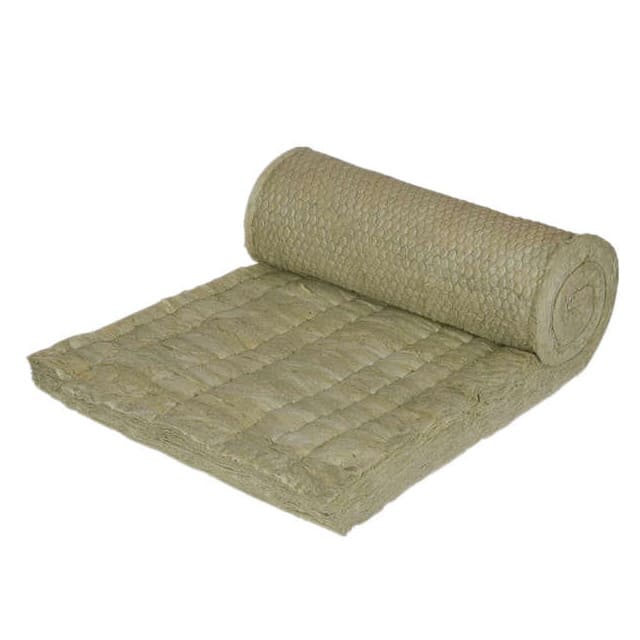
How to construct and apply rock wool roll felt with wire mesh as insulation material for power plants? In the insulation engineering of pipelines and equipment in power plants, there is a standard process for the construction of rock wool roll felt with wire mesh (also known as steel wire mesh rock wool joint felt). Its biggest feature is that the outer wire mesh is like a "steel skeleton", which can tightly wrap around the internal rock wool, especially suitable for parts with high vibration and high requirements for the integrity of the insulation layer such as power plant boilers and large-diameter hot air pipelines.
In power plants, rock wool roll felt with wire mesh (usually galvanized or stainless steel wire) is a commonly used insulation material. Its construction application needs to strictly follow the specifications to ensure insulation effect, structural stability, and operational safety. After installing the insulation layer and wire mesh, a metal protective layer should be added outside to prevent rain and mechanical damage. Power plants usually use galvanized iron sheet or aluminum sheet. During installation, attention should be paid to overlapping the joints smoothly (with the upper plate pressing the lower plate to prevent rainwater backflow), and fixed with rivets to ensure a smooth and beautiful appearance. Construction process for laying and fixing rock wool roll felt: 1. Cutting and wrapping
Cut the rock wool roll felt according to the outer circumference of the pipeline or equipment. Wrap the felt around the pipe wall to ensure tight seams and no gaps. 2. Misaligned tiling
This is the key to avoiding "thermal bridges". When laying a single layer, the joints should be staggered (the seams should be staggered), and when laying multiple layers, the joints should be pressed (the seams of the upper and lower layers should be staggered by at least 150mm) to prevent heat from dissipating through the direct gaps. 3. Wire mesh fixation (core steps)
Binding wire mesh: Use galvanized wire to securely bind the outer wire mesh with rock wool. For power plant pipelines, the wire diameter is generally between 1.2mm-2.5mm (thicker wire is used for larger diameters), tied every 200-300mm, and the wire head should be tightened and pressed into the insulation layer to prevent scratches or the formation of thermal bridges.
Welding hook nail fixation (mostly used for large equipment/pipelines): First weld insulation hook nails on the surface of equipment or large pipelines, pass the felt through the hook nails, and then use self-locking pressure plates to press and fix the wire mesh.
How to construct and apply rock wool roll felt with wire mesh as insulation material for power plants? In power plants, rock wool roll felt with wire mesh (usually galvanized or stainless steel wire) is a commonly used insulation material. Its construction application needs to strictly follow the specifications to ensure insulation effect, structural stability, and operational safety.


.jpg)