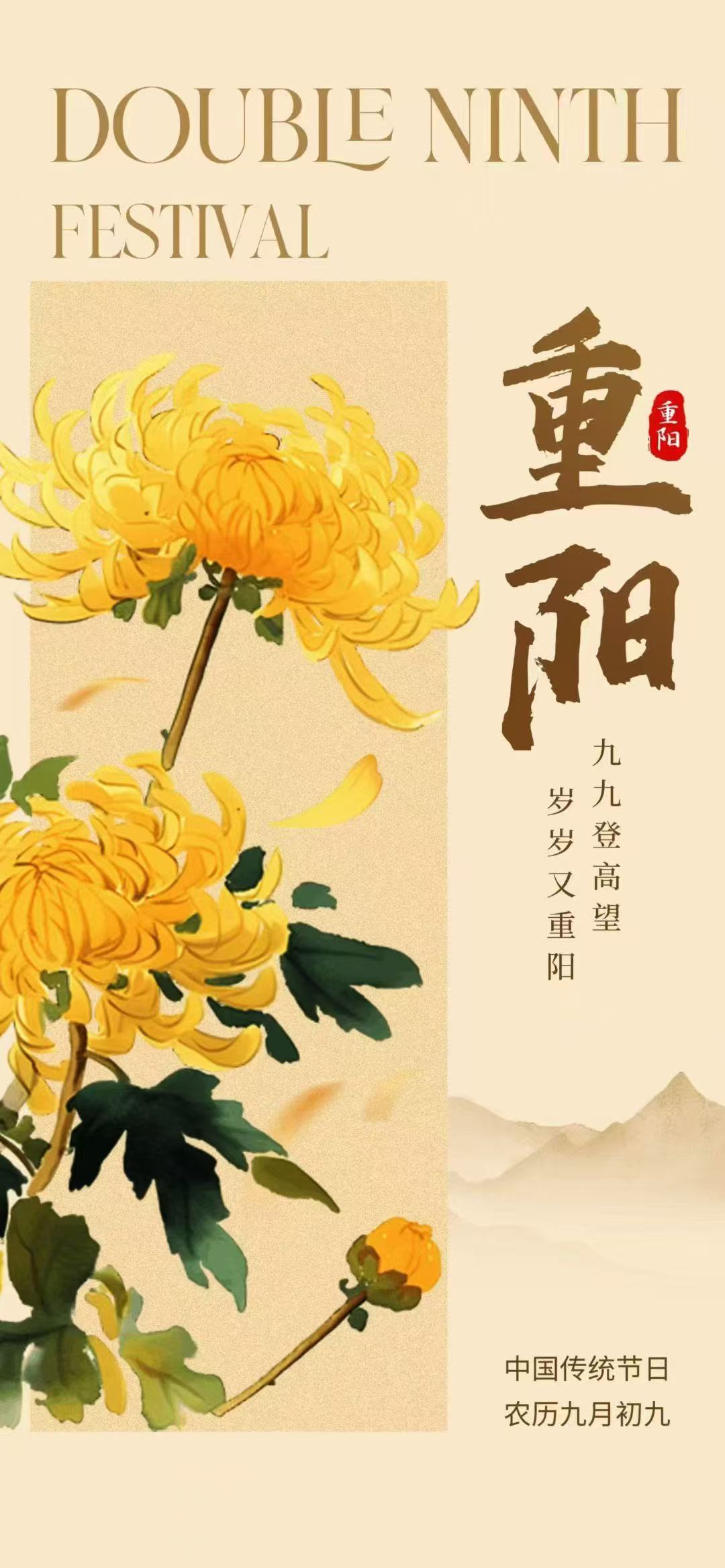
The warm autumn colors of the Double Ninth Festival deepen our respect for the elderly. Today is Double Ninth Festival, may Double Ninth enjoy health and happiness for a long time.
Today is the Double Ninth Festival, also known as the Nine Heavens Festival, the Cornus Festival, the Climbing Festival, and the Respect for the Elderly Festival. It is a festival in China that celebrates harvest, pray for longevity, and expresses respect and love for the elderly. It falls on the ninth day of the ninth lunar month every year.
The Origin of Double Ninth Festival
The origin of Chongyang Festival can be traced back to ancient times, and it is said that Chongyang is the day when Emperor Yuan attained enlightenment. The earliest existing written record of the customs and activities of the Double Ninth Festival can be found in the "Ji Qiu Ji" of the "L ü shi Spring and Autumn Annals": "In September, the tomb was ordered to be slaughtered, and agricultural preparations were made for harvest, with five important items listed. The items collected by the Tibetan emperor in the divine granary were only to be respected and ordered. On that day, a grand feast was offered to the emperor, and sacrifices were made and reported to the emperor
It can be seen that at that time, there were already activities to worship the Heavenly Emperor and ancestors during the autumn harvest of crops in September, to express gratitude for the kindness of the Heavenly Emperor and ancestors. This was the primitive form of the Double Ninth Festival as a sacrificial activity in ancient times. There are also large-scale banquet activities that developed from the pre Qin harvest celebration banquet. Therefore, worshiping gods and ancestors, seeking longevity, and banquets constitute the basic content of the Double Ninth Festival.
The Double Ninth Festival was popularized in the Western Han Dynasty, and its name was first recorded in writing during the Three Kingdoms period. The Tang Dynasty was an important period for the integration and shaping of traditional festival customs, and its main part has been passed down. During the Song Dynasty, the Han ethnic group's Double Ninth Festival customs had already been accepted by minority groups in the north. The Double Ninth Festival during the Yuan, Ming, and Qing dynasties basically continued various customs of the Song Dynasty, and can be called the continuation period of the Double Ninth Festival.
The name "Chongyang" comes from the ancient book "Yi Jing" which states that "the yang line is nine". In the Book of Changes, "six" is defined as the yin number, "nine" as the yang number, and also as the "extreme number", referring to the height of the sky as the "nine levels". The number "nine" represents the old yang, which is the number of anodes. The two anode numbers are weighted together, and the nine and nine return to one. The origin of one element and the renewal of all things are significant. Therefore, ancient people believed that Double Ninth was an auspicious day worth celebrating. On the ninth day of the ninth lunar month, when both the sun and the moon are on the ninth day, it is called "Double Ninth" due to the weight of the two nines. At the same time, when two yang numbers are combined, it is called "Double Ninth". In the Ming Dynasty, Zhang Dai wrote in his book "Night Voyage Ship": "Nine is the number of yang, and its day corresponds to the moon, hence it is called 'Chongyang'


.png)