Rosewool Insulation Refractory Co.,Ltd.


What types of ceramic fiber blankets are required for insulation materials of power plant steam turbines? Due to its own working principle, the temperature of the main cylinder, main reheat steam pipeline, and cylinder wall shell of the power plant steam turbine is generally 350-540 ℃. The unit experiences vibration and temperature fluctuations during start-up and shutdown, so it is more necessary to use needle punched ceramic fiber blankets (aluminum silicate needle punched blankets) instead of spray blankets. The tensile strength should be high, and the resistance to vibration and thermal cycling shrinkage should be small.
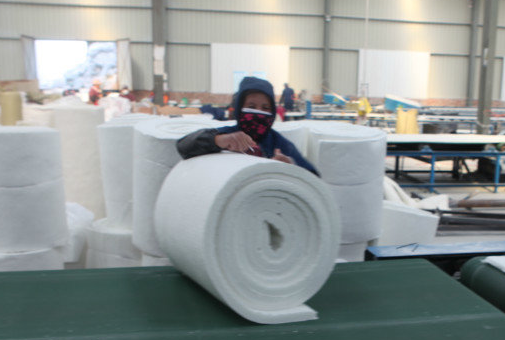
The maximum temperature of the cylinder wall is 540 ℃, and a standard 1260 ℃ spinning needle punched ceramic fiber blanket is selected with a bulk density of 128-160kg/m ³, no binder, double-sided needle punched, high tensile strength, resistance to start stop thermal shock, and linear shrinkage ≤ 3%.
The temperature of the low-pressure cylinder is too low, and a standard blanket of 96-128kg/m ³ 1260 can be used.
Similarly, the 1260 ℃ spinning needle punched blanket weighs 128kg/m ³; The inner layer of the jacket is equipped with 1260 ceramic fiber cloth, which is convenient for disassembly and maintenance. Low density soft blankets cannot be used, as they are prone to powdering and falling off.
Priority: 1260 high-purity spun silk needle punched blanket, 128kg/m ³; High end projects use nano aerogel felt+ceramic fiber blanket composite structure to reduce the total thickness of insulation.
We do not recommend the regular 1050 model, as it tends to experience significant thermal shrinkage over a long period of time at temperatures above 500 ℃; Zirconium blanket 1430 grade steam turbines are generally not used and belong to ultra-high temperature redundancy, resulting in high costs.
The continuous vibration during the operation of the steam turbine makes the hard calcium silicate board prone to cracking, detachment, and pulverization;
The temperature of the unit changes repeatedly during startup and shutdown, and the ceramic fiber undergoes thermal expansion and contraction. It has good thermal cycling resistance and is not easily cracked after repeated temperature rise and fall.
The steam turbine cylinder body cannot withstand excessive insulation loads. The bulk density of ceramic fiber blanket is 128-160kg/m ³, which is much lower than that of hard refractory insulation material, reducing the load on the cylinder shell and not adding additional equipment load.
The turbine cylinder has many curved surfaces, flanges, bolts, concave and convex corners, and irregular shapes. Flexible ceramic fiber blanket can be cut, bent, staggered and laid to fit irregular shells; It can also serve as the inner core of a detachable insulation sleeve, making it convenient for later maintenance and disassembly.
High quality needle punched ceramic fiber blanket contains almost no organic binder, and is smoke-free and non-volatile when heated. It will not contaminate the turbine lubricating oil system with oil stains or impurities, ensuring the safety of the unit.
What types of ceramic fiber blankets are required for insulation materials of power plant steam turbines? The steam turbine has continuous vibration and frequent cold and hot start stop, and a double-sided needle punched 1260 ℃ ceramic fiber blanket with a bulk density of 128-160kg/m ³ must be selected; Spray blanket and low-density blanket have poor tensile strength, resulting in powder collapse after operation, which can cause excessive heat dissipation in the cylinder body and large temperature differences between the upper and lower cylinders, affecting the safe operation of the unit.
The ceramic fiber blanket produced by Rosewool Insulation Refractory Co.,Ltd. specifically for steam turbines has a bulk density of 128-160kg/m ³, high tensile strength, excellent resistance to vibration and thermal cycling, and ensures the safe and stable operation of the unit. The product has low slag ball content, almost no organic binder, and no volatile substances when heated. The flexible material can adapt to complex irregular structures such as cylinder surfaces and flanges. It can be used as a fixed insulation or as a detachable insulation sleeve core, making it convenient for later maintenance and disassembly.